Playbook retrieval
Ask how your own setup rules define a valid trade, what conditions must be present, or which exceptions were documented previously.
Trading ideas often live across PDFs, notes, checklists, playbooks, and research documents. Argos AI Trading Library gives those materials a private home inside the platform so users can upload documents, process them, search them, and ask questions with answers tied back to source references. That makes it easier to work from your own material instead of relying on memory or generic prompts, while keeping the research flow user-controlled.
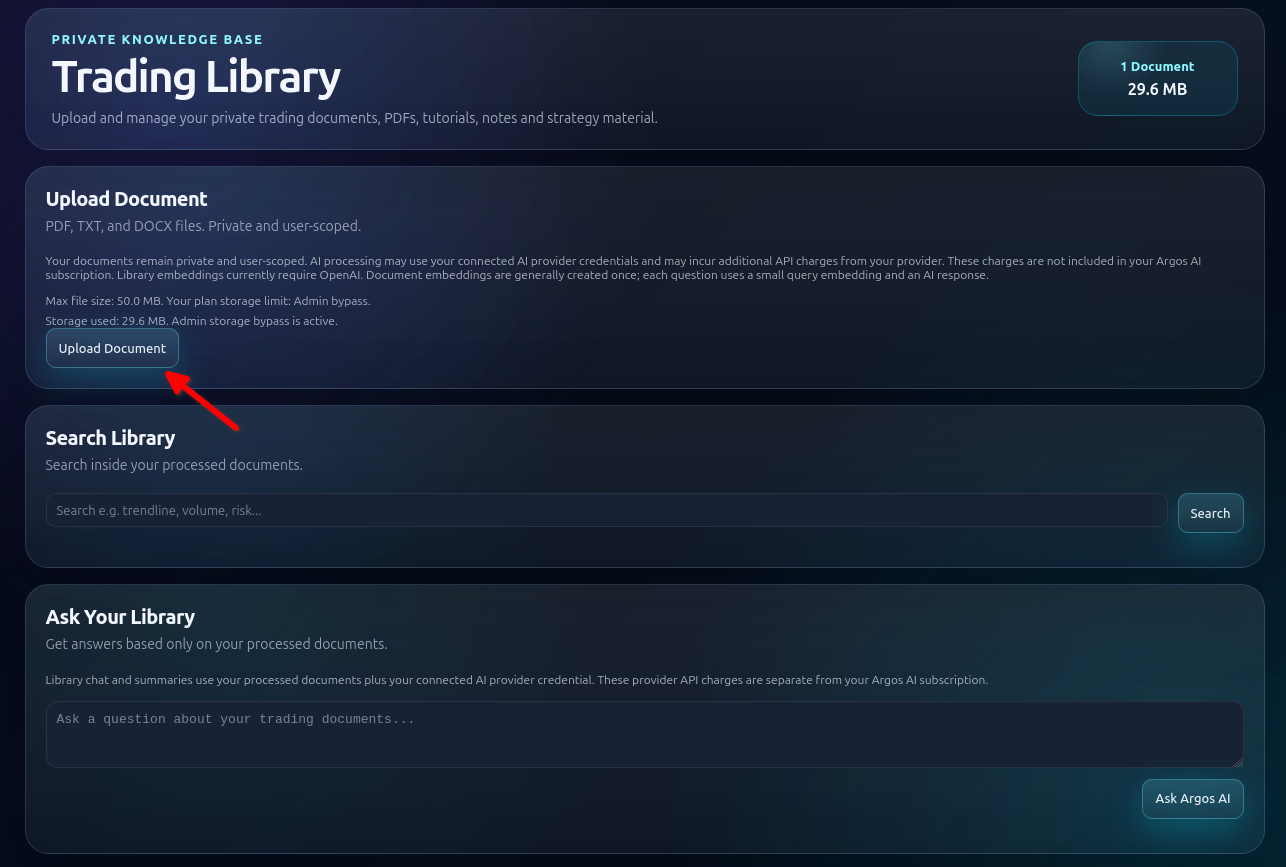
A trading process often depends on more than current market data. It depends on rules, playbooks, examples, post-trade notes, and reference material collected over time. Without a usable library, that knowledge becomes harder to retrieve under pressure. Traders end up searching folders, opening PDFs manually, or asking an AI model questions without grounding it in the documents that actually matter to their process.
Trading Library addresses that problem by letting users keep the source material in one place and then query it more naturally. That can save time, but more importantly it helps keep answers anchored to the user's own research base instead of drifting into generic commentary.
After a document is uploaded and processed, it becomes part of the user's searchable library. From there, the trader can search by theme, ask direct questions, and inspect the supporting references that led to an answer. This is useful for playbook review, checklist validation, and recalling what a stored note actually said.
It also fits naturally with the rest of the platform. A workflow can produce an analysis, the journal can capture the outcome, and the library can hold the longer-form reasoning material that supports future decisions.
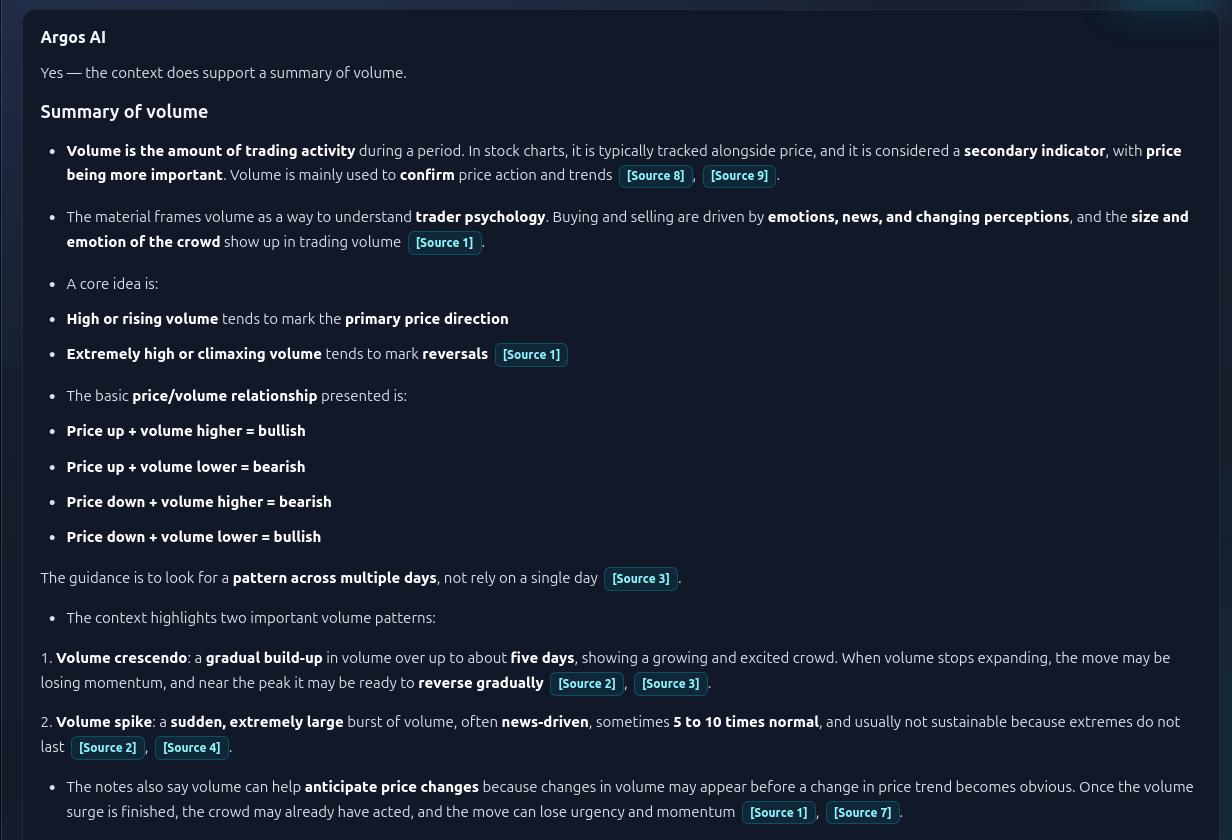
Ask how your own setup rules define a valid trade, what conditions must be present, or which exceptions were documented previously.
Revisit stored notes and documents when you want to compare a current market situation with prior written observations.
Receive answers that can cite the stored material used, making it easier to verify whether the response matches the underlying document.
The library is most helpful when it stays connected to the other Argos AI features without becoming a public knowledge dump. Traders can pair it with AI Trading Analysis workflows, Crypto Analysis routines, Trading Journal review notes, and Edge Analyzer feedback loops.
That combination matters because useful research usually becomes more valuable when it can influence AI-assisted preparation, review, and iteration instead of sitting in a folder untouched.